Statistical Entropy Analysis of Network Data
Project summary
In multivariate statistics, there is an abundance of different measures of centrality and spread, many of which cannot be applied on variables measured on nominal or ordinal scale. Since network data in majority comprises such variables, alternative measures for analyzing spread, flatness and association is needed. This is also of particular relevance given the special feature of interdependent observations in networks.
Multivariate entropy analysis is a general statistical method for analyzing and finding dependence structure in data consisting of repeated observations of variables with a common domain and with discrete finite range spaces. Only nominal scale is required for each variable, so only the size of the variable’s range space is important but not its actual values. Variables on ordinal or numerical scales, even continuous numerical scales, can be used, but they should be aggregated so that their ranges match the number of available repeated observations. By investigating the frequencies of occurrences of joint variable outcomes, complicated dependence structures, partial independence and conditional independence as well as redundancies and functional dependence can be found.
R package netropy
Package overview



This package introduces these entropy tools in the context of network data. Brief description of various functions implemented in the package are given in the following but more details are provided in the package vignettes and the references listed.
Installation
You can install the released version of netropy from CRAN with:
install.packages("netropy")The development version from GitHub with:
# install.packages("devtools")
devtools::install_github("termehs/netropy")
Statistical Entropy Analysis of Network Data
Multivariate entropy analysis is a general statistical method for analyzing and finding dependence structure in data consisting of repeated observations of variables with a common domain and with discrete finite range spaces. Only nominal scale is required for each variable, so only the size of the variable’s range space is important but not its actual values. Variables on ordinal or numerical scales, even continuous numerical scales, can be used, but they should be aggregated so that their ranges match the number of available repeated observations. By investigating the frequencies of occurrences of joint variable outcomes, complicated dependence structures, partial independence and conditional independence as well as redundancies and functional dependence can be found.
This package introduces these entropy tools in the context of network data. Brief description of various functions implemented in the package are given in the following but more details are provided in the package vignettes and the references listed.
library('netropy')Loading Internal Data
The different entropy tools are explained and illustrated by exploring data from a network study of a corporate law firm, which has previously been analysed by several authors (link). The data set is included in the package as a list with objects representing adjacency matrices for each of the three networks advice (directed), friendship (directed) and co-work (undirected), together with a data frame comprising 8 attributes on each of the 71 lawyers.
To load the data, extract each object and assign the correct names to them:
data(lawdata)
adj.advice <- lawdata[[1]]
adj.friend <- lawdata[[2]]
adj.cowork <-lawdata[[3]]
df.att <- lawdata[[4]]
Variable Domains and Data Editing
A requirement for the applicability of these entropy tools is the specification of discrete variables with finite range spaces on the same domain: either node attributes/vertex variables, edges/dyad variables or triad variables. These can be either observed or transformed as shown in the following using the above example data set.
We have 8 vertex variables with 71 observations, two of which (years and age) are numerical and needs categorization based on their cumulative distributions. This categorization is in details described in the vignette “variable domains and data editing”. Here we just show the new dataframe created (note that variable senior is omitted as it only comprises unique values and that we edit all variable to start from 0):
att.var <-
  data.frame(
    status   = df.att$status-1,
    gender   = df.att$gender,
    office   = df.att$office-1,
    years    = ifelse(df.att$years <= 3,0,
                      ifelse(df.att$years <= 13,1,2)),
    age      = ifelse(df.att$age <= 35,0,
                      ifelse(df.att$age <= 45,1,2)),
    practice = df.att$practice,
    lawschool= df.att$lawschool-1
    )
head(att.var)
#>   status gender office years age practice lawschool
#> 1      0      1      0     2   2        1         0
#> 2      0      1      0     2   2        0         0
#> 3      0      1      1     1   2        1         0
#> 4      0      1      0     2   2        0         2
#> 5      0      1      1     2   2        1         1
#> 6      0      1      1     2   2        1         0
These vertex variables can be transformed into dyad variables by using the function get_dyad_var(). Observed node attributes in the dataframe att_var are then transformed into pairs of individual attributes. For example, status with binary outcomes is transformed into dyads having 4 possible outcomes \((0,0), (0,1), (1,0), (1,1)\):
dyad.status    <- get_dyad_var(att.var$status, type = 'att')
dyad.gender    <- get_dyad_var(att.var$gender, type = 'att')
dyad.office    <- get_dyad_var(att.var$office, type = 'att')
dyad.years     <- get_dyad_var(att.var$years, type = 'att')
dyad.age       <- get_dyad_var(att.var$age, type = 'att')
dyad.practice  <- get_dyad_var(att.var$practice, type = 'att')
dyad.lawschool <- get_dyad_var(att.var$lawschool, type = 'att')
Similarly, dyad variables can be created based on observed ties. For the undirected edges, we use indicator variables read directly from the adjacency matrix for the dyad in question, while for the directed ones (advice and friendship) we have pairs of indicators representing sending and receiving ties with 4 possible outcomes :
dyad.cwk    <- get_dyad_var(adj.cowork, type = 'tie')
dyad.adv    <- get_dyad_var(adj.advice, type = 'tie')
dyad.frn    <- get_dyad_var(adj.friend, type = 'tie')
All 10 dyad variables are merged into one data frame for subsequent entropy analysis:
dyad.var <-
  data.frame(cbind(status   = dyad.status$var,
                  gender    = dyad.gender$var,
                  office    = dyad.office$var,
                  years     = dyad.years$var,
                  age       = dyad.age$var,
                  practice  = dyad.practice$var,
                  lawschool = dyad.lawschool$var,
                  cowork    = dyad.cwk$var,
                  advice    = dyad.adv$var,
                  friend    = dyad.frn$var)
                  )
head(dyad.var)
#>   status gender office years age practice lawschool cowork advice friend
#> 1      3      3      0     8   8        1         0      0      3      2
#> 2      3      3      3     5   8        3         0      0      0      0
#> 3      3      3      3     5   8        2         0      0      1      0
#> 4      3      3      0     8   8        1         6      0      1      2
#> 5      3      3      0     8   8        0         6      0      1      1
#> 6      3      3      1     7   8        1         6      0      1      1
A similar function get_triad_var() is implemented for transforming vertex variables and different relation types into triad variables. This is described in more detail in the vignette “variable domains and data editing”.
Univariate, Bivariate and Trivariate Entropies
The function entropy_bivar() computes the bivariate entropies of all pairs of variables in the dataframe. The output is given as an upper triangular matrix with cells giving the bivariate entropies of row and column variables. The diagonal thus gives the univariate entropies for each variable in the dataframe:
H2 <- entropy_bivar(dyad.var)
H2
#>           status gender office years   age practice lawschool cowork advice
#> status     1.493  2.868  3.640 3.370 3.912    3.453     4.363  2.092  2.687
#> gender        NA  1.547  3.758 3.939 4.274    3.506     4.439  2.158  2.785
#> office        NA     NA  2.239 4.828 4.901    4.154     5.058  2.792  3.388
#> years         NA     NA     NA 2.671 4.857    4.582     5.422  3.268  3.868
#> age           NA     NA     NA    NA 2.801    4.743     5.347  3.411  4.028
#> practice      NA     NA     NA    NA    NA    1.962     4.880  2.530  3.127
#> lawschool     NA     NA     NA    NA    NA       NA     2.953  3.567  4.186
#> cowork        NA     NA     NA    NA    NA       NA        NA  0.615  1.687
#> advice        NA     NA     NA    NA    NA       NA        NA     NA  1.248
#> friend        NA     NA     NA    NA    NA       NA        NA     NA     NA
#>           friend
#> status     2.324
#> gender     2.415
#> office     3.044
#> years      3.483
#> age        3.637
#> practice   2.831
#> lawschool  3.812
#> cowork     1.456
#> advice     1.953
#> friend     0.881
Bivariate entropies can be used to detect redundant variables that should be omitted from the dataframe for further analysis. This occurs when the univariate entropy for a variable is equal to the bivariate entropies for pairs including that variable. As seen above, the dataframe dyad.var has no redundant variables. This can also be checked using the function redundancy() which yields a binary matrix as output indicating which row and column variables are hold the same information:
redundancy(dyad.var)
#> no redundant variables
#> NULL
More examples of using the function redundancy() is given in the vignette “univariate bivariate and trivariate entropies”.
Trivariate entropies can be computed using the function entropy_trivar() which returns a dataframe with the first three columns representing possible triples of variables V1,V2, and V3 from the dataframe in question, and their entropies H(V1,V2,V3) as the fourth column. We illustrated this on the dataframe dyad.var:
H3 <- entropy_trivar(dyad.var)
head(H3, 10) # view first 10 rows of dataframe
#>         X      Y         Z H(X,Y,Z)
#> 1  status gender    office    4.938
#> 2  status gender     years    4.609
#> 3  status gender       age    5.129
#> 4  status gender  practice    4.810
#> 5  status gender lawschool    5.664
#> 6  status gender    cowork    3.464
#> 7  status gender    advice    4.048
#> 8  status gender    friend    3.685
#> 9  status office     years    5.321
#> 10 status office       age    5.721
Joint Entropy and Association Graphs
Joint entropies is a non-negative measure of association among pairs of variables. It is equal to 0 if and only if two variables are completely independent of each other.
The function joint_entropy() computes the joint entropies between all pairs of variables in a given dataframe and returns a list consisting of the upper triangular joint entropy matrix (univariate entropies in the diagonal) and a dataframe giving the frequency distributions of unique joint entropy values. A function argument specifies the precision given in number of decimals for which the frequency distribution of unique entropy values is created (default is 3). Applying the function on the dataframe dyad.var with two decimals:
J <- joint_entropy(dyad.var, 2)
J$matrix
#>           status gender office years  age practice lawschool cowork advice
#> status      1.49   0.17   0.09  0.79 0.38     0.00      0.08   0.02   0.05
#> gender        NA   1.55   0.03  0.28 0.07     0.00      0.06   0.00   0.01
#> office        NA     NA   2.24  0.08 0.14     0.05      0.13   0.06   0.10
#> years         NA     NA     NA  2.67 0.61     0.05      0.20   0.02   0.05
#> age           NA     NA     NA    NA 2.80     0.02      0.41   0.01   0.02
#> practice      NA     NA     NA    NA   NA     1.96      0.04   0.05   0.08
#> lawschool     NA     NA     NA    NA   NA       NA      2.95   0.00   0.01
#> cowork        NA     NA     NA    NA   NA       NA        NA   0.62   0.18
#> advice        NA     NA     NA    NA   NA       NA        NA     NA   1.25
#> friend        NA     NA     NA    NA   NA       NA        NA     NA     NA
#>           friend
#> status      0.05
#> gender      0.01
#> office      0.08
#> years       0.07
#> age         0.05
#> practice    0.01
#> lawschool   0.02
#> cowork      0.04
#> advice      0.18
#> friend      0.88
J$freq
#>       j  #(J = j) #(J >= j)
#> 1  0.79         1         1
#> 2  0.61         1         2
#> 3  0.41         1         3
#> 4  0.38         1         4
#> 5  0.28         1         5
#> 6   0.2         1         6
#> 7  0.18         2         8
#> 8  0.17         1         9
#> 9  0.14         1        10
#> 10 0.13         1        11
#> 11  0.1         1        12
#> 12 0.09         1        13
#> 13 0.08         4        17
#> 14 0.07         2        19
#> 15 0.06         2        21
#> 16 0.05         7        28
#> 17 0.04         2        30
#> 18 0.03         1        31
#> 19 0.02         5        36
#> 20 0.01         5        41
#> 21    0         4        45
As seen, the strongest association is between the variables status and years with joint entropy values of 0.79. We have independence (joint entropy value of 0) between two pairs of variables: (status,practice), (practise,gender), (cowork,gender),and (cowork,lawschool).
These results can be illustrated in a association graph using the function assoc_graph() which returns a ggraph object in which nodes represent variables and links represent strength of association (thicker links indicate stronger dependence). To use the function we need to load the ggraph library and to determine a threshold which the graph drawn is based on. We set it to 0.15 so that we only visualize the strongest associations
library(ggraph)
assoc_graph(dyad.var, 0.15)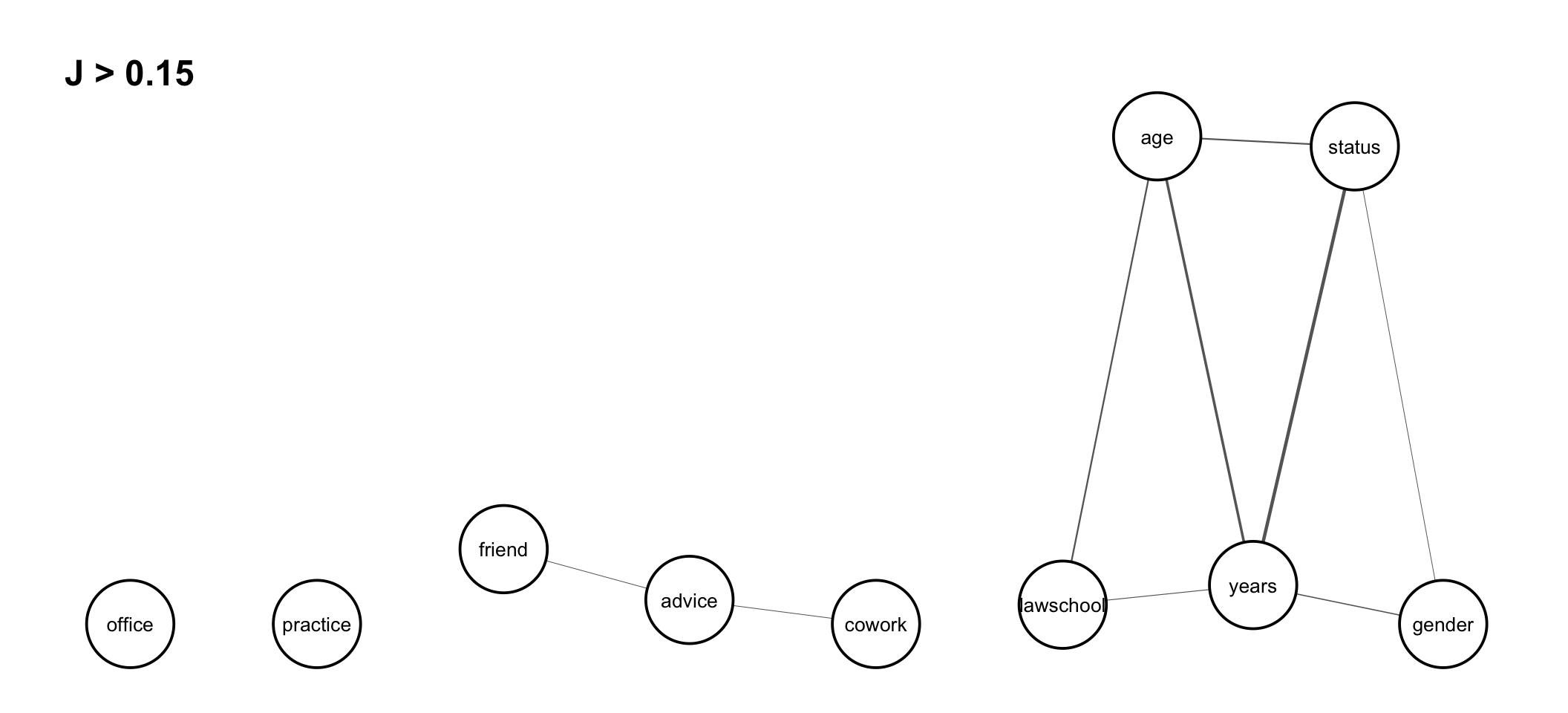
Given this threshold, we see isolated and disconnected nodes representing independent variables. We note strong dependence between the three dyadic variables status,years and age, but also a somewhat strong dependence among the three variables lawschool, years and age, and the three variables status, years and gender. The association graph can also be interpreted as a tendency for relations cowork and friend to be independent conditionally on relation advice, that is, any dependence between dyad variables cowork and friend is explained by advice.
A threshold that gives a graph with reasonably many small independent or conditionally independent subsets of variables can be considered to represent a multivariate model for further testing.
More details and examples of joint entropies and association graphs are given in the vignette “joint entropies and association graphs”.
Prediction Power Based on Expected Conditional Entropies
The function prediction_power() computes prediction power when pairs of variables in a given dataframe are used to predict a third variable from the same dataframe. The variable to be predicted and the dataframe in which this variable also is part of is given as input arguments, and the output is an upper triangular matrix giving the expected conditional entropies of pairs of row and column variables (denoted \(X\) and \(Y\)) of the matrix, i.e. EH(Z|X,Y) where \(Z\) is the variable to be predicted. The diagonal gives EH(Z|X) , that is when only one variable as a predictor. Note that NA’s are in the row and column representing the variable being predicted.
Assume we are interested in predicting the variable status (that is, whether a lawyer in the data set is an associate or partner). This is done by computing the prediction power matrix:
pred_status <- prediction_power("status", dyad.var)
pred_status
#>           status gender office years   age practice lawschool cowork advice
#> status        NA     NA     NA    NA    NA       NA        NA     NA     NA
#> gender        NA  1.375  1.180 0.670 0.855    1.304     1.225  1.306  1.263
#> office        NA     NA  2.147 0.493 0.820    1.374     1.245  1.373  1.325
#> years         NA     NA     NA 2.265 0.573    0.682     0.554  0.691  0.667
#> age           NA     NA     NA    NA 1.877    1.089     0.958  1.087  1.052
#> practice      NA     NA     NA    NA    NA    2.446     1.388  1.459  1.410
#> lawschool     NA     NA     NA    NA    NA       NA     3.335  1.390  1.337
#> cowork        NA     NA     NA    NA    NA       NA        NA  2.419  1.400
#> advice        NA     NA     NA    NA    NA       NA        NA     NA  2.781
#> friend        NA     NA     NA    NA    NA       NA        NA     NA     NA
#>           friend
#> status        NA
#> gender     1.270
#> office     1.334
#> years      0.684
#> age        1.058
#> practice   1.427
#> lawschool  1.350
#> cowork     1.411
#> advice     1.407
#> friend     3.408
For better readability, the predictive strengths of different variables can be compared using a heatmap representation. The plot displays a color-coded matrix with rows corresponding to \(X\) and columns to \(Y\), where darker cells indicate higher predictive power (i.e., lower prediction uncertainty for status:
make_pred_plot(pred_status, "Prediction Power for Status")
Obviously, the darkest color is obtained when the variable to be predicted is included among the predictors, and the cells exhibit prediction power for a single predictor on the diagonal and for two predictors symmetrically outside the diagonal. Some findings are as follows: good predictors for status are given by years in combination with any other variable, and age in combination with any other variable. The best sole predictor is gender.
More details and examples of expected conditional entropies and prediction power are given in the vignette “prediction power based on expected conditional entropies”.
Divergence Tests of Goodness of Fit
Occurring cliques in association graphs represent connected components of dependent variables, and by comparing the graphs for different thresholds, specific structural models of multivariate dependence can be suggested and tested. The function div_gof() allows such hypothesis tests.
The function div_gof() provides a formal way to test whether simplified dependence structures suggested by the association graph are consistent with the observed data.
Example 1: Conditional Independence
From the association graph above, we observed that the variables friend, cowork, and advice form a connected component. This suggests the model
\[\text{friend} \perp \text{cowork} \mid \text{advice},\]
meaning that any dependence between friendship and co-working may be explained by the advice relation.
This can be tested as follows:
div_gof(
  dat = dyad.var,
  var1 = "friend",
  var2 = "cowork",
  var_cond = "advice"
)
#>                                        test     D   chi2 df critical_value
#> 1 friend independent of cowork given advice 0.003 11.959 12         21.798
#>        decision
#> 1 cannot reject
Since the model is not rejected, this supports the interpretation that advice explains the association between friend and cowork.
Example 2: Pairwise Independence
We can also test whether two variables are independent without conditioning. For example,
\[\text{cowork} \perp \text{gender},\]
which was suggested by a joint entropy value close to zero:
div_gof(
  dat = dyad.var,
  var1 = "cowork",
  var2 = "gender"
)
#>                           test     D   chi2 df critical_value decision
#> 1 cowork independent of gender 0.005 16.538  3          7.899   reject
Since this model is rejected, it indicates that the two variables are statistically indeepndent.
These tests provide a useful bridge between exploratory entropy analysis and formal statistical modeling. While association graphs suggest candidate structures, divergence-based tests allow us to assess whether such simplified models adequately describe the observed data.
References
Parts of the theoretical background is provided in the package vignettes, but for more details, consult the following literature:
Frank, O., & Shafie, T. (2016). Multivariate entropy analysis of network data. Bulletin of Sociological Methodology/Bulletin de Méthodologie Sociologique, 129(1), 45-63. link